



The short answer
To start a medical clinic in the US, you choose your services, confirm your state lets you own the practice the way you plan to, form the entity and get an EIN and NPIs, get state licenses, DEA and CLIA where needed, enroll with Medicare, Medicaid and insurers, build out a space, put HIPAA and OSHA compliance in place, hire and train your team, and start marketing before you open. Plan on six months to a year from commitment to first patient. Physicians Thrive
The order matters because some steps take months and block others. Payer enrollment and licensing usually set the pace, so they start early while the space is being built.
1. Decide what kind of clinic you are building
Start with the services, the patients and how you will be paid. A primary care practice that bills insurance, a cash-pay med spa and a neuropathy clinic selling care plans are different businesses, with different licenses, staff, equipment and marketing.
- Insurance, cash-pay or both. Insurance brings volume but slow cash. Cash-pay is faster but needs stronger marketing.
- Who provides care. Your state’s rules for nurse practitioners and physician assistants decide how you can staff it.
- Specialty rules. Aesthetics, IV therapy, weight loss and men’s health each have their own regulatory traps. See our guides to starting a med spa, an IV therapy business, a weight loss clinic and a men’s health clinic.
2. Check who is allowed to own it
There is no federal rule on who can own a medical practice. States decide, through what lawyers call the corporate practice of medicine doctrine. In states that enforce it, only licensed physicians can own a medical practice, usually through a professional corporation or PLLC. National Law Review
Non-physician founders in those states often own a management services organization (MSO) instead. The MSO runs the business side, such as billing and staffing, under a management agreement, and the physician-owned practice delivers care. Hendershot Cowart
States are tightening these structures. Oregon’s SB 951, signed in June 2025, limits MSO ownership of medical practices and MSO control of clinical decisions, starting in 2026 for new entities. Sidley Check your state in the table below, then confirm the structure with a healthcare attorney.
3. Build the plan and the budget
Your business plan should answer three questions: how many patients you need to break even, how long it will take to get there, and how you will pay the bills until then.
- Startup costs. Industry estimates put most practices between about $70,000 and $500,000, with lean solo practices under $100,000 and procedure-heavy practices higher. Physicians Thrive We break this down in how much it costs to start a clinic.
- Working capital. Plan for three to six months of operating costs, because insurance payments typically lag 60 to 90 days. Physicians Thrive
- Financing. SBA 7(a) loans go up to $5 million and can fund working capital, equipment, build-out and real estate. SBA
4. Form the entity and get an EIN
Register the practice entity with your state’s business filing office, usually the Secretary of State, in the form your state requires for medical practices. Then apply for an Employer Identification Number. The IRS issues EINs free online, often immediately, and recommends forming the entity first. IRS
5. Get your NPIs
Every clinician needs a Type 1 National Provider Identifier, and an incorporated practice gets a Type 2 NPI for the organization. Apply through NPPES, which CMS says is the fastest route. CMS NPPES
6. Get licenses and registrations
- State medical licenses come from each state’s medical board, listed by the FSMB. The Interstate Medical Licensure Compact offers a faster route in its member states, 44 as of September 2026. IMLCC
- DEA registration is needed to prescribe controlled substances, after you hold a state license. New practitioners apply on DEA Form 224, and the fee is $888 for three years. DEA DOJ OIG Many states also require their own controlled substance registration and prescription monitoring enrollment, covered in each state guide.
- A CLIA certificate is required for any lab testing on patients, even simple waived tests. A Certificate of Waiver costs $248 every two years, and all CLIA certificates last two years. CMS CMS fee schedule
- Facility licenses and certificate of need. Most states do not license ordinary physician offices, but many license urgent care, surgery centers, pain clinics or other facility types. 35 states and DC run certificate of need programs, which can apply to surgery centers, imaging or major equipment. NCSL
7. Enroll with Medicare, Medicaid and insurers
Start this as early as you can. It is usually the longest step.
- Medicare. Enroll online in PECOS. Each clinician files a CMS-855I, which now also covers reassignment of benefits, and the group or clinic files a CMS-855B. CMS One Medicare contractor reports finishing 95% of online applications without a site visit within 15 days and all within 50 days, longer when a site visit is needed. First Coast
- Medicaid is run by each state, so you enroll with your state Medicaid agency. Each state guide links to the right one. GAO
- Commercial insurers use the CAQH provider data portal, now run by DataSpring. It is free, and profiles must be re-attested every 120 days. DataSpring Enrollment with a single insurer commonly takes four to six months, sometimes about two. Physicians Thrive
8. Secure the space and build it out
Choose a location your patients can reach easily, with parking, signage and room to grow. Plan patient flow from the front desk to the treatment rooms. A real location also matters for marketing: Google Business Profile requires a physical place customers can visit, so a virtual office or mailing address does not qualify. Google
9. Put compliance in place
- HIPAA. The Security Rule requires administrative, physical and technical safeguards for electronic patient data and a documented risk analysis. HHS proposed major changes in December 2024, and the current rule stays in force while that rulemaking continues. HHS
- Business associate agreements with every vendor that handles patient data, including your EHR, billing company and marketing agency if it touches patient information. HHS
- OSHA. If staff may be exposed to blood, you need a written exposure control plan covering safer needles, protective equipment, training and hepatitis B vaccination. OSHA
- Malpractice insurance. Decide between claims-made and occurrence cover, and plan for tail cover if you leave a claims-made policy. Physicians Thrive
- Telehealth prescribing. Federal flexibilities that let DEA-registered clinicians prescribe controlled substances by telemedicine without an in-person visit run through December 31, 2026, and a permanent rule was still under review in October 2026. HHS
10. Hire, train and set up systems
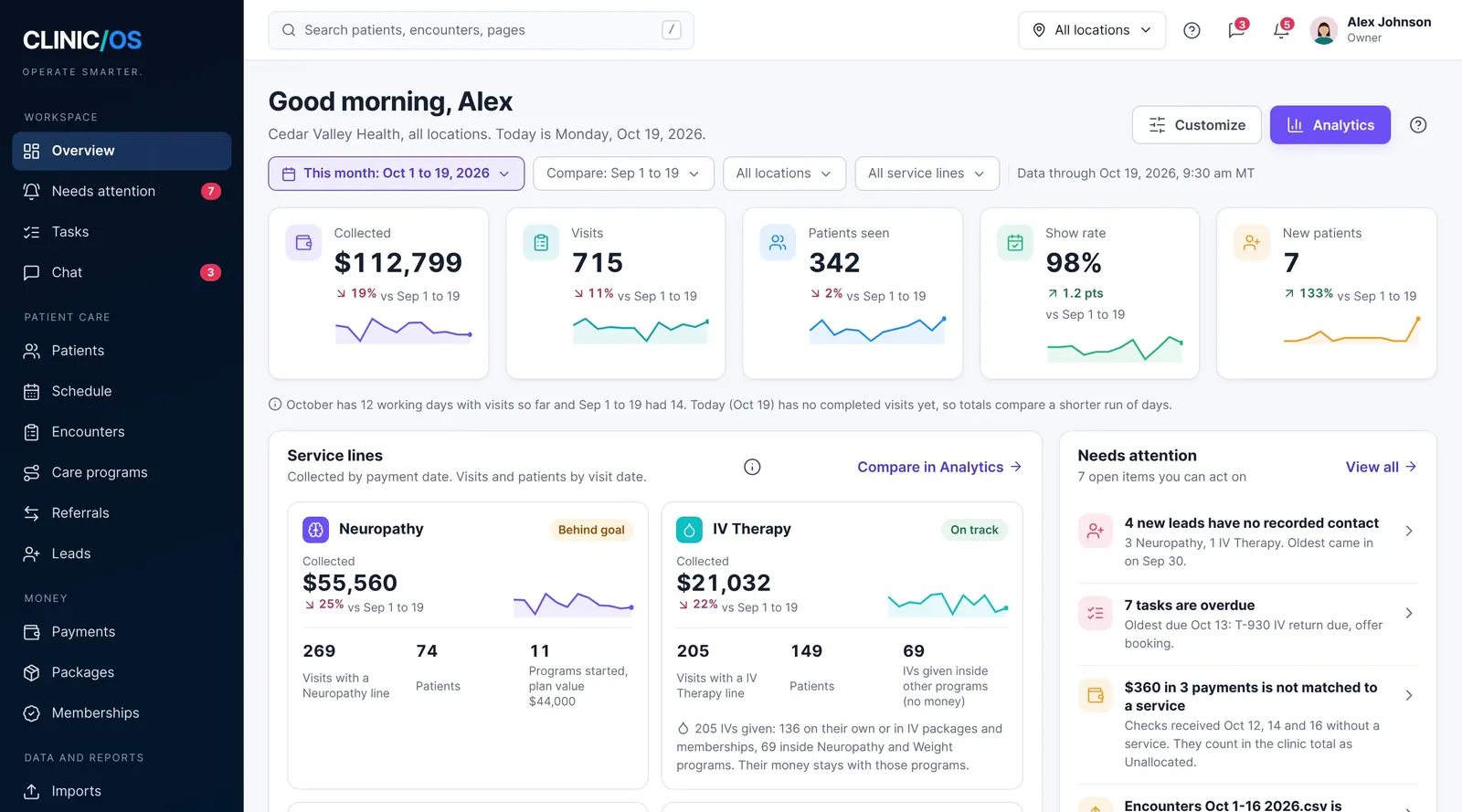
Hire for the front desk as carefully as the clinical team, because they answer the calls your marketing pays for. Set up your EHR, scheduling, phones and a way to see every enquiry and follow-up in one place. ONC’s long-standing estimate for buying and installing an EHR is $15,000 to $70,000 per provider, based on older studies, so get current quotes. HealthIT.gov Our clients get Clinic OS and Staff OS to run the clinic and the team.
11. Market before you open
An empty schedule in the first month is the most expensive problem a new clinic can have. Patients now start with reviews: in one survey, 71% of patients said online reviews were their first step in finding a new doctor. Software Advice (2020)
- Claim your Google Business Profile as soon as you have the address.
- Launch a fast website with a page for every service and online booking.
- Start local search and social ads four to eight weeks before opening, with an opening offer or founding patient list.
- Film the team and the space and post weekly.
- Set up instant lead alerts and a follow-up routine, so no enquiry waits. See our speed to lead guide.
Starting a clinic: rules by state
The biggest differences between states are who can own a practice, whether a certificate of need applies and how independently nurse practitioners can work. Of the 51 jurisdictions below, 28 give nurse practitioners full practice authority and 36 run a certificate of need program. Pick your state for the details, the agencies and the sources.
| State | Corporate practice of medicine | Certificate of need | NP practice authority |
|---|---|---|---|
| Alabama | Limited | Yes | Reduced practice |
| Alaska | No clear bar | Yes | Full practice |
| Arizona | Limited | No | Full practice |
| Arkansas | Unclear | Yes | Reduced practice |
| California | Strict | No | Restricted practice |
| Colorado | Moderate | No | Full practice |
| Connecticut | Unclear | Yes | Full practice |
| Delaware | Unclear | Yes | Full practice |
| District of Columbia | Unclear | Yes | Full practice |
| Florida | Limited | Yes | Restricted practice |
| Georgia | No clear bar | Yes | Restricted practice |
| Hawaii | No clear bar | Yes | Full practice |
| Idaho | No clear bar | No | Full practice |
| Illinois | Strict | Yes | Reduced practice |
| Indiana | Moderate | Yes | Reduced practice |
| Iowa | Moderate | Yes | Full practice |
| Kansas | Strict | No | Full practice |
| Kentucky | Moderate | Yes | Reduced practice |
| Louisiana | Moderate | Yes | Reduced practice |
| Maine | Limited | Yes | Full practice |
| Maryland | Moderate | Yes | Full practice |
| Massachusetts | Moderate | Yes | Full practice |
| Michigan | Moderate | Yes | Restricted practice |
| Minnesota | Moderate | No | Full practice |
| Mississippi | Limited | Yes | Reduced practice |
| Missouri | No clear bar | Yes | Restricted practice |
| Montana | No clear bar | Yes | Full practice |
| Nebraska | Limited | Yes | Full practice |
| Nevada | Moderate | Yes | Full practice |
| New Hampshire | No clear bar | No | Full practice |
| New Jersey | Moderate | Yes | Reduced practice |
| New Mexico | Limited | No | Full practice |
| New York | Strict | Yes | Full practice |
| North Carolina | Strict | Yes | Restricted practice |
| North Dakota | Moderate | No | Full practice |
| Ohio | Limited | Yes | Reduced practice |
| Oklahoma | No clear bar | Yes | Restricted practice |
| Oregon | Strict | Yes | Full practice |
| Pennsylvania | No clear bar | No | Reduced practice |
| Rhode Island | No clear bar | Yes | Full practice |
| South Carolina | No clear bar | Yes | Restricted practice |
| South Dakota | Moderate | No | Full practice |
| Tennessee | Moderate | Yes | Restricted practice |
| Texas | Strict | No | Restricted practice |
| Utah | No clear bar | No | Full practice |
| Vermont | Unclear | Yes | Full practice |
| Virginia | Unclear | Yes | Restricted practice |
| Washington | Unclear | Yes | Full practice |
| West Virginia | Unclear | Yes | Reduced practice |
| Wisconsin | Moderate | No | Reduced practice |
| Wyoming | Unclear | No | Full practice |
Corporate practice levels summarize each state’s guide. They are a starting point for a conversation with your attorney, not a legal opinion.